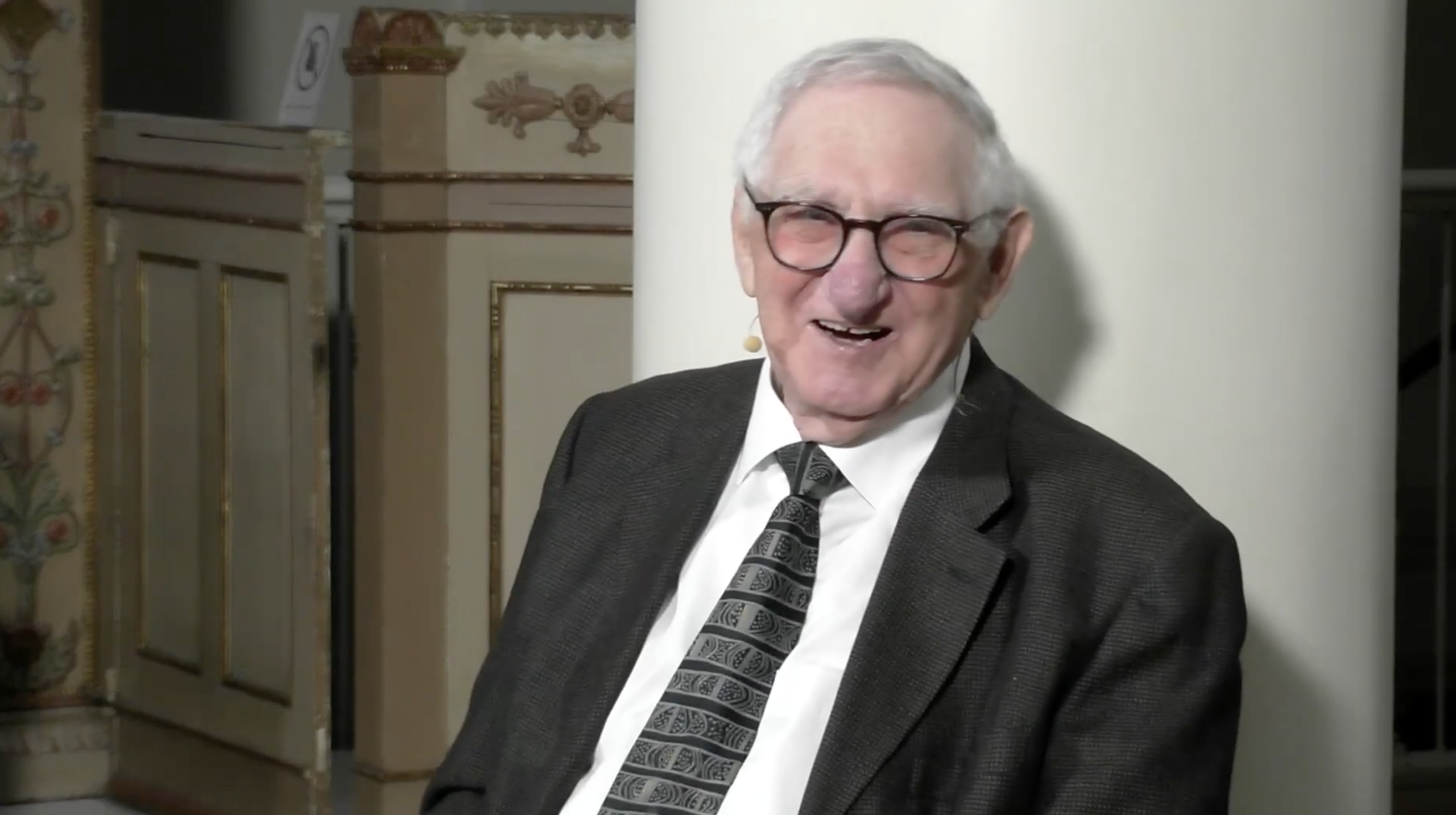
Chief Rabbi Emeritus Morton Narrowe at the Jewish Museum in Stockholm, January 2025.
A Life of Encounters – A Conversation with Chief Rabbi Morton Narrowe
What would Jews have done had history been reversed – if Judaism had become the religion of an empire and Jews had held power over others?
This was a question a young Morton Narrowe once posed to his teacher. Decades later, it remains strikingly relevant. What does power do to our understanding of ourselves and others? What can history teach us about responsibility, identity and the possibility of moving forward in a world marked by violence and polarisation?
In a conversation with Erika Hedenström at the Jewish Museum in Stockholm, Chief Rabbi Emeritus Morton Narrowe reflects on a life shaped by encounters: within the Jewish community and, perhaps just as importantly, across religious boundaries.
Arriving in Sweden from the United States in 1965, Narrowe became part of a Jewish community undergoing profound change. Over the decades, dialogue with Christians and other religious communities became central to his work. He also served on the national committee responsible for translating the Bible and the Apocrypha into Swedish.
For Narrowe, genuine dialogue is much more demanding than simply meeting or cooperating. It requires honesty, curiosity and a willingness to remain rooted in one’s own tradition while taking another person’s beliefs seriously.
Such conversations are only possible when there is trust. The closer we come to questions of faith and identity, Narrowe argues, the greater the risk of hurting one another. Meaningful theological conversation may require us to challenge the other person, even to suggest that they have misunderstood something within their own tradition. This is only possible when both parties trust each other’s intentions – when the purpose is neither to hurt nor to win an argument, but to search for truth together.
This connects to a broader ethical principle that has guided Narrowe throughout his life: tocho kevaro – that a person’s inside should be like their outside. What we say and what we do must correspond. Trust, in Narrowe’s account, is not merely essential to interfaith dialogue but a foundation for society itself.
One of the most thought-provoking moments in the conversation concerns the historical relationship between Christianity and Judaism. Narrowe recalls a question he put as a young rabbinical student to his teacher, the medieval historian Professor Abraham Halkin: what would Jews have done had history been reversed, if Judaism had become the religion of an empire and Jews had held power over others?
Halkin’s answer stayed with him. Jews, he said, would probably have behaved in much the same way. To understand history, we must enter the mindset of the period. Persecution was not simply a consequence of one particular religion; it was also bound up with how power itself was understood. Those who held power believed their dominance reflected divine favour and therefore justified their exercise of power over others.
For Narrowe, this does not diminish Christianity’s responsibility for centuries of antisemitism and persecution. Historical wrongs must be acknowledged. But Halkin’s perspective adds another dimension: we should be cautious about assuming moral superiority simply because history placed us among the persecuted rather than the powerful. Recognition of past injustice should not become an obstacle to encounter, but a foundation from which to move forward.
Ultimately, Narrowe’s understanding of dialogue rests on a belief in shared humanity. Real dialogue allows people to remain different, to question one another and to recognise each other’s peculiarities and shortcomings. But this requires trust – the belief that the person across from us wishes us well. Without trust, differences become threats. With it, they can become the beginning of an honest conversation.
This conversation that took place in January 2025 was part of a series of three talks exploring different perspectives on religious dialogue. Jointly organised by the Jewish Museum in Stockholm and the Robert Weil Family Foundation, the series was a gift to Chief Rabbi Emeritus Morton Narrowe on the occasion of his 90th birthday.
Watch the full conversation here