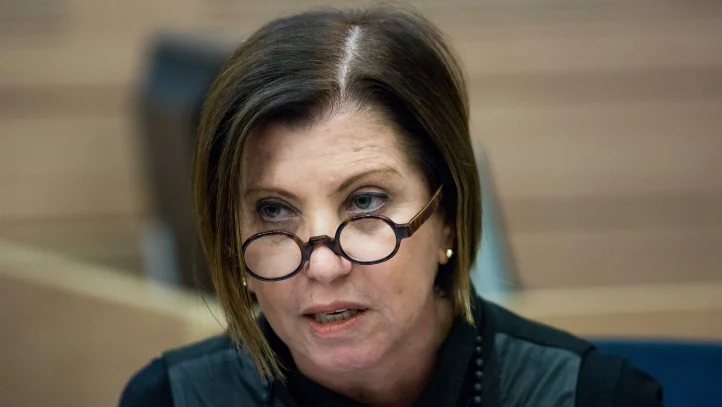
The Danger Was Never Netanyahu – a text by Zehava Galon
The Danger Was Never Netanyahu. It Won’t Disappear Even When He’s Gone.
We are at a historic crossroads. An enormous wave of optimism swept millions to the polls, giving our politicians an unprecedented opportunity to change course just before we go over the cliff. Yet instead of relief, I see people convinced that all is lost. That may turn out to be true, but whether it does is up to the leaders of the so-called bloc of change. Because one thing should be clear by now, after our 20,000th election in the past decade: In Israel, the person who forms a government is the one who can assemble a coalition of 61 Knesset seats. As things stand, Prime Minister Benjamin Netanyahu doesn’t have such a coalition.
The bloc of change’s leaders now face a single question. Would they rather give another six months to the ultra-Orthodox declaration that “We have no faith in the rule of heretics” coalition, to Miri Regev’s “diamonds” system, which reportedly offered preferential treatment to Likud activists who could deliver votes for her in party primaries, and to Jewish terrorism? Would they rather give the blockchain a chance and hope that, by some miracle, their candidates will do better in the next election? Or are they prepared to seize this opportunity and form a government? Yes, with Arab votes. You know, Arabs are citizens of Israel.
These elections make clear, to anyone who still needs to be reminded, that Netanyahu isn’t the only challenge we face. He gained his power by exploiting a struggle that has raged for years over Israel’s soul: the struggle between a liberal democracy and a racist, violent ethnocracy. That struggle didn’t begin with Bibi, and it doesn’t end with him. This moment offers a chance to settle it. We must not squander that chance. And the struggle must begin with a Jewish-Arab coalition.
It was impossible to live through the past four years without feeling under attack. Not from Hamas, Iran or Hezbollah, but from within — from the government that was supposed to protect us and instead chose to behave like an autoimmune disease, destroying the body that sustains it. The judicial coup, police violence and various pieces of legislation did not constitute the essence of that attack. They were different expressions of a deeper assault on our values, aimed directly at our identity.
“If the people don’t want the Declaration of Independence, they’ll find a way to abolish the Declaration of Independence,” former Supreme Court President Aharon Barak said this week, in an interview on the Kan public broadcaster’s “Mishpat Hozer” (“Retrial”) podcast. “Do you think that’s where we’re heading?” the interviewer asked. “We’ll see what the results are,” Barak replied. You would have had to be blind and deaf to think Barak had misunderstood what was happening or was exaggerating. He was describing reality as it is.
This is a government that supplied Jewish terrorists armed with weapons, all-terrain vehicles and military protection. As Jewish terrorism grew, the government told us its perpetrators were just a negligible handful, a few kids, that it didn’t exist at all and that the real problem was “anarchists.” That same government subjected peaceful, law-abiding demonstrations against its coup to the most violent treatment the police could offer, from water-cannon blasts to humiliating strip searches. It sent Knesset members to insult people who had threatened to stop volunteering for military service if the coup legislation went through — people who went off to risk their lives the moment they were called up. At the same time, it did everything it could to allow entire communities to refuse to serve en masse.
This goes beyond the good old gaslighting we’ve all grown accustomed to during the Netanyahu years. It’s a real conflict of values. A fundamental disagreement over good and evil, over what is legitimate and what is unacceptable. When far-right National Missions Minister Orit Strock spoke of “an era of miracles” while Israeli hostages were being tortured in Gaza tunnels and hundreds of thousands of Israelis had fled their homes in the north and south — she meant every word. We must understand that. We must grasp the depth of the abyss. Our very survival is at stake. Yet so many people around me remain convinced that Netanyahu is the problem, perhaps Itamar Ben-Gvir too, and that if we just get them out of the way, everything will sort itself out. That is a dangerous mistake. We have no time to keep denying what is right before our eyes.
Netanyahu did not create this moral fault line. He exploited it, broadened it and made political capital out of it. He made it the foundation of his rule. But if it hadn’t been Netanyahu, it would’ve been someone else. The opportunity was there for anyone cynical enough, racist enough and sufficiently devoid of empathy to seize it. We have discovered that there is no shortage of such people. We know the ideology we’re up against. It’s been with us since before we even gave it its current name. It’s called Kahanism. And we must be clear: We have not defeated this ideology.
Meir Kahane gave his name to the ideology of Jewish supremacy, but he didn’t invent it. This danger has stalked the Zionist project from its inception. Herzl warned of this very moment in his utopian book “Altneuland.” In that novel, that ideology is represented by Dr. Geyer, a fanatical rabbi leading a movement that demanded the revocation of non-Jewish residents’ civil and voting rights and the establishment of a regime of religious and ethnic supremacy in Israel. In Herzl’s utopia, Israel comes to its senses and defeats Geyer at the ballot box. In the real Israel, his ideas are still with us, and many swear by them.
Kahanism in Israel is no curiosity, no lunatic fringe shouting “Death to Arabs” in the streets. It has long since ceased to be a narrow political category confined to the handful of seats held by a single extremist party. It has become a way of thinking, a language, a legislative framework and official government policy. In the outgoing Knesset, it had representatives in both the coalition and the opposition. That’s another reason this moment is so dangerous.
The same people wearing the same suits offer us the same fear, hatred and racist logic. We must not accept it. Israel needs more than a change of personnel. It needs its soul back. It must make moral choices that go beyond sharing the burden of military service equally.
It is no coincidence that Israel’s Kahanization went hand in hand with the judicial coup. The concepts of Jewish supremacy, ethnic cleansing and racist exclusion cannot flourish under a democratic system. Substantive democracy is more than a mechanism. It’s a set of values. Institutionalized Jewish supremacy and nationalist terrorism operating with impunity cannot coexist with an independent court or an attorney general who insists on upholding the law. The judicial coup was therefore much more than a whim of Justice Minister Yariv Levin and Simcha Rothman, the far-right chairman of the Knesset’s Constitution, Law and Justice Committee. It was an essential tool for destroying the institutions that stood in the way of unchecked Kahanist hegemony.
Kahanism cannot flourish in a democratic Israel, in part because the country has a large Arab minority with the right to vote, alongside a much larger Arab minority denied that right. Hence all the attempts to suppress Arab voting and portray it as illegitimate: raising the electoral threshold to eliminate the community’s parties, which responded by uniting and growing stronger; the Central Elections Committee’s decisions to disqualify every single Arab party; and the long campaign to portray these parties as “supporters of terror,” traitorous and even — oh, the horror — “non-Zionist”!
Shamefully, the people who did the most to normalize this process were well-mannered politicians from the “moderate center.” Whether out of political cowardice, a hunger for seats or moral blindness, they were the first to embrace the racist premises of the far right. Some preferred to keep Netanyahu’s governments on life support rather than be accused of entering a Jewish-Arab partnership. They chose Kahanists, con artists and opportunists, turning a fifth of the country’s citizens into political pariahs. They helped pave Ben-Gvir’s path to the National Security Ministry.
We still risk falling into that trap. The same people are wearing the same suits and offering us the same fear, the same hatred and the same racist logic. We must not accept it. Israel needs more than a change of personnel. It needs its soul back. It must make real, moral choices that go far beyond sharing the burden of military service equally.
At the Zulat institute, we are proposing a process of de-Kahanization that will require technical, institutional and legal work too. We will need to identify and repeal discriminatory laws, throw corrupt and racist appointees out of public service, establish oversight committees and set up a proper state commission of inquiry to investigate the events of October 7. But de-Kahanization is first and foremost a moral choice. It will require creating an intellectual and moral alternative to the obsession with the “purity of blood” that has poisoned everything good here. This process must begin with Jewish-Arab partnership.
That partnership is necessary not only because it is the sole route to a coalition, but because a democratic country simply cannot keep ignoring a fifth of its citizens. Equality is not an act of charity bestowed by the Jewish majority upon the minority. It is a basic condition of democracy. Lawmaker Ahmad Tibi, head of the Ta’al party, once said that Israel is “democratic for its Jews and Jewish for its Arabs.” These years have taught us that no such democracy exists. A democracy that is “Jewish for its Arabs” quickly heads down a very dark path.
The second pillar of Israeli society’s de-Kahanization must be the complete, resolute and systematic eradication of Jewish terrorism and nationalist violence. For far too long, the authorities have turned a blind eye to this malignant growth, when they have not backed it outright. A country cannot survive when armed militias burn villages, attack soldiers and try to drag us into establishing settlements in Syria and Lebanon.
The third pillar, perhaps the most important of all, is ending the occupation. Fifty-nine years of ruling over another people have corrupted us from within. They have gradually accustomed us to the idea that a people can live alongside us without enjoying either voting rights or civil rights. They have disguised collective punishment, dispossession and endless wars as “security.” They have brought us neither security nor peace nor respite. The territories have been a poison pill. It’s time to give them up.
We have an opportunity to restore the words torn out of public discourse: hope, peace, equality, justice, a horizon. Simply a horizon. We have gone too far down the path of the Kahanist vision to settle for the drab promise of a technocratic government that will simply do no harm. That would be nice, a refreshing change after the nightmare we have just endured, but it would not be enough. Israeli society must summon the moral courage to rebuild itself from the ruins as a country founded on equality, solidarity and peace. That means making courageous decisions now. It’s time for a little courage. We really are standing at the edge of a precipice, and we cannot afford to keep sliding downward, if only a little more slowly this time.
By Zehava Galon
Published in Haaretz on October 29, 2026